Listen on:









Episodes
Tuesday Apr 15, 2025
Tuesday Apr 15, 2025
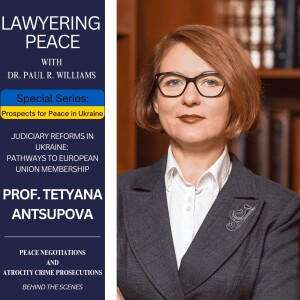
How is Ukraine reforming its judiciary while defending itself from Russian aggression?
What role does judicial reform play in Ukraine’s pursuit of EU membership and democratic transformation?In this episode, Prof. Tetyana Antsupova joins Dr. Paul R. Williams on the Lawyering Peace podcast.
Prof. Antsupova—former Supreme Court judge of Ukraine and British Academy Research Fellow—shares personal and professional reflections on the sweeping judicial reforms unfolding in Ukraine since 2014.
This episode examines how Ukraine is rebuilding judicial institutions in line with EU standards, balancing wartime pressures with long-term goals. Prof. Antsupova highlights the role of international experts, civil society, and European partners in building trust, advancing independence, and fostering resilience within the judiciary.
She also reflects on lessons from other EU states, the unique challenges of judicial reform during active conflict, and the urgent need for long-term strategic planning and public confidence in the rule of law.
This conversation demonstrates how Ukraine’s judiciary stands as a testament to resilience and reform in the face of aggression.
-----------------------Ukraine and its allies stand at a critical juncture as they pursue a just and lasting peace and an end to Russia’s war of aggression. The road ahead is fraught with difficult issues that will arise during a future peace process, from territorial integrity and post-war security frameworks to EU accession and justice and accountability.
In this special mini-series, Prospects for Peace In Ukraine, we sit down with Ukrainian and international experts in law, diplomacy, and peace negotiations to explore some of these key issues. Together, we examine the strategies, options, and opportunities ahead as Ukraine and its allies navigate the peace process against a shifting international landscape.
Monday Apr 14, 2025
Monday Apr 14, 2025
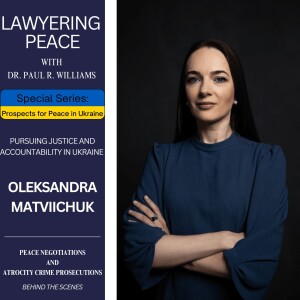
Is the system of international law today capable of effectively achieving justice and accountability for Ukraine?
How can accountability be made central to a future peace process—and not sacrificed for short-term political gain?
In the latest episode of the Lawyering Peace podcast, Oleksandra Matviichuk, Nobel Peace Laureate and Head of the Center for Civil Liberties, joins Dr. Paul R. Williams to discuss the pursuit of justice and accountability for atrocity crimes committed during Russia’s war of aggression.
Matviichuk outlines a comprehensive vision of justice—from prosecution and reparations to public truth-telling and recognition—and highlights the need for a Special Tribunal for the Crime of Aggression.
She warns against the sidelining of justice in peace negotiations, and calls for reform of the global legal order to adequately address impunity for international crimes. At the heart of her message is a powerful reminder: even when institutions falter, people have the power to shape history.
-----------------------Ukraine and its allies stand at a critical juncture as they pursue a just and lasting peace and an end to Russia’s war of aggression. The road ahead is fraught with difficult issues that will arise during a future peace process, from territorial integrity and post-war security frameworks to EU accession and justice and accountability.
In this special mini-series, Prospects for Peace In Ukraine, we sit down with Ukrainian and international experts in law, diplomacy, and peace negotiations to explore some of these key issues. Together, we examine the strategies, options, and opportunities ahead as Ukraine and its allies navigate the peace process against a shifting international landscape.
Thursday Apr 10, 2025
Thursday Apr 10, 2025
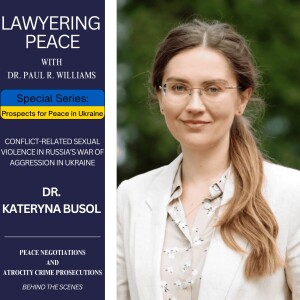
How has Russia used conflict-related sexual violence as a tool in its war of aggression?
What does meaningful justice for survivors of Russia’s conflict-related sexual violence look like? In this episode, Dr. Kateryna Busol joins Dr. Paul R. Williams on the Lawyering Peace podcast.
Dr. Busol explores the widespread and systematic use of conflict-related sexual violence (CRSV) by Russian forces in Ukraine. Dr. Busol explores how societal norms and toxic gender hierarchies in Russia fuel the use of CRSV as a weapon of Russian aggression, and the impact on both survivors and Ukrainian society at large.
She thoughtfully explains the challenges that survivors face in seeking justice, and the ways in which female victims have spearheaded the effort to advocate for male survivors of CRSV.
Dr. Busol stresses the need for survivor-centered, gender-sensitive approaches to accountability, emphasizing that reparations should include not just financial compensation but also rehabilitation, symbolic recognition, and guarantees of non-repetition.
This discussion underscores the intersection of CRSV with broader peace and justice issues, highlighting the importance of a meaningful and holistic justice process. Dr. Busol reminds us that addressing such violence is key to achieving a sustainable, survivor-centered peace.
The conversation demonstrates the need to pursue a meaningful and holistic justice process for survivors of CRSV. Dr. Busol underscores the ways in which conflict-related sexual violence intersects with broader issues of peace and justice, demonstrating that addressing such violence is essential for a sustainable and survivor-centered peace.
-----------------------Ukraine and its allies stand at a critical juncture as they pursue a just and lasting peace and an end to Russia’s war of aggression. The road ahead is fraught with difficult issues that will arise during a future peace process, from territorial integrity and post-war security frameworks to EU accession and justice and accountability.
In this special mini-series, Prospects for Peace In Ukraine, we sit down with Ukrainian and international experts in law, diplomacy, and peace negotiations to explore some of these key issues. Together, we examine the strategies, options, and opportunities ahead as Ukraine and its allies navigate the peace process against a shifting international landscape.
Thursday Apr 03, 2025
Thursday Apr 03, 2025
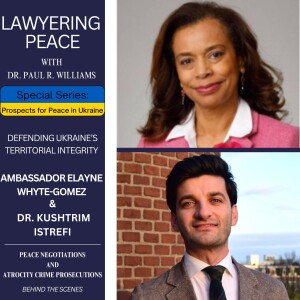
How can Ukraine protect its territorial integrity in peace negotiations?
What role does the international community play in ensuring that no territory is lost? In this episode, Ambassador Elayne Whyte Gómez of Costa Rica and member of PILPG’s Circle of Former Ambassadors, and Professor Kushtrim Istrefi of Utrecht University and PILPG Senior Peace Fellow, join the conversation.
Ambassador Gómez and Professor Istrefi explore questions relating to Ukraine’s territorial integrity and the central importance of maintaining its rightful territorial claims during peace negotiations.
Negotiations to end Russia’s war have gained momentum in recent weeks. However, the question of Ukraine’s occupied territories and their future status remains a key concern for Ukraine and its allies as they consider what a future peace agreement may look like.
Russia continues to deny the validity of Ukraine’s rightful claim to its internationally recognized borders as of 1991, and seeks to portray its war of aggression as . However, as our guests demonstrate, Ukraine’s claim is firmly rooted in international law. Our experts discuss the risks of unresolved territorial disputes, the role of international law, and outline practical tools at Ukraine and its allies’ disposal to maintain Ukraine’s territorial claim during peace negotiations, including international administration and non-recognition strategies.
In a war which Russia consistently claims is based on self-defense and self-determination, our guests remind us that it is crucial to keep focus on the reality of Russia’s invasion as a war of aggression against the territorial sovereignty of Ukraine. Tune in for a compelling discussion on how Ukraine can push back against historical distortions, build alliances, and secure its future.
-----------------------Ukraine and its allies stand at a critical juncture as they pursue a just and lasting peace and an end to Russia’s war of aggression. The road ahead is fraught with difficult issues that will arise during a future peace process, from territorial integrity and post-war security frameworks to EU accession and justice and accountability.
In this special mini-series, Prospects for Peace In Ukraine, we sit down with Ukrainian and international experts in law, diplomacy, and peace negotiations to explore some of these key issues. Together, we examine the strategies, options, and opportunities ahead as Ukraine and its allies navigate the peace process against a shifting international landscape.
Monday Mar 24, 2025
Monday Mar 24, 2025
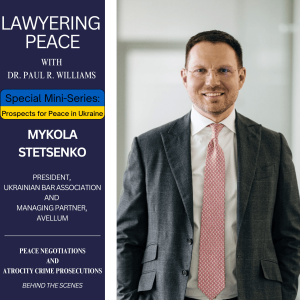
In this episode of Lawyering Peace, we are joined by Mykola Stetsenko, President of the Ukrainian Bar Association, who speaks about the pivotal role of private sector investment in Ukraine’s post-war reconstruction. The conversation explores key industries primed for growth—agriculture, manufacturing, IT, energy, and logistics—as well as investment mechanisms such as public-private partnerships and industrial parks.
Stetsenko explains how Ukraine’s natural resource ownership model simplifies foreign investment, the government’s push to modernize industries rather than merely rebuild, and efforts to align with EU regulations. He also addresses common misconceptions about investing in Ukraine, the challenge of balancing economic development with environmental sustainability, and the policies designed to attract foreign investors by streamlining bureaucracy and fostering innovation.
With major multinationals already operating in the country and digital transformation reducing red tape, Ukraine presents compelling opportunities for forward-thinking investors. Tune in to discover how businesses can play a vital role in post-war recovery while seizing high-impact investment opportunities.
-----------------------Ukraine and its allies stand at a critical juncture as they pursue a just and lasting peace and an end to Russia’s war of aggression. The road ahead is fraught with difficult issues that will arise during a future peace process, from territorial integrity and post-war security frameworks to EU accession and justice and accountability.
In this special mini-series, Prospects for Peace In Ukraine, we sit down with Ukrainian and international experts in law, diplomacy, and peace negotiations to explore some of these key issues. Together, we examine the strategies, options, and opportunities ahead as Ukraine and its allies navigate the peace process against a shifting international landscape.
Thursday Mar 20, 2025
Thursday Mar 20, 2025
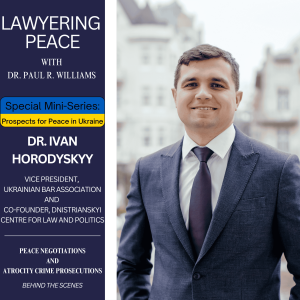
Our second guest in our Series on Prospects for Peace in Ukraine is Dr. Ivan Horodyskyy, Vice-President of the Ukrainian Bar Association and Director and Cofounder of the Dnistrianskyi Centre for Law and Politics, where he manages projects related to compensation for Ukrainians for damages caused by Russian aggression.
Since Russia’s 2022 full-scale invasion, Ukraine and its allies have called for Russia to bear responsibility for its illegal acts, including making reparation, to widespread international support. In this episode, we discuss the question of reparations for Russia’s extensive war damage in Ukraine, as well as the closely related issues of frozen Russian assets and postwar reconstruction.
Significant challenges lie ahead in negotiating reparations for Ukraine: what might a compensation mechanism look like, how should reparations be funded, what role should Russia’s frozen assets play, and how can Russia be made to pay? With Ivan, we explore these questions and more and consider the challenges and strategies for the future negotiation of reparations for Ukraine.--------------------------Ukraine and its allies stand at a critical juncture as they pursue a just and lasting peace and an end to Russia’s war of aggression. The road ahead is fraught with difficult issues that will arise during a future peace process, from territorial integrity and post-war security frameworks to EU accession and justice and accountability.
In this special mini-series, Prospects for Peace In Ukraine, we sit down with Ukrainian and international experts in law, diplomacy, and peace negotiations to explore some of these key issues. Together, we examine the strategies, options, and opportunities ahead as Ukraine and its allies navigate the peace process against a shifting international landscape.
Wednesday Mar 05, 2025
Wednesday Mar 05, 2025
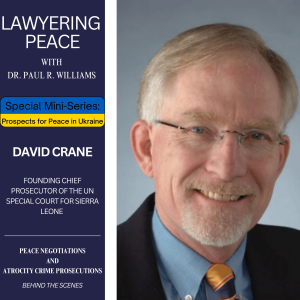
Tune in for insights from Professor David Crane, Founding Chief Prosecutor of the UN Special Court for Sierra Leone.
This episode discusses David’s recent blog post with PILPG, in which he explores a potential ceasefire model for Ukraine, inspired by the successful Multinational Force and Observers established for the Sinai Peninsula. The conversation also covers the rise of power-centric diplomacy, the future role of the UN, and the strategic considerations for Ukraine and its allies in an increasingly uncertain international order.
-----------------------Ukraine and its allies stand at a critical juncture as they pursue a just and lasting peace and an end to Russia’s war of aggression. The road ahead is fraught with difficult issues that will arise during a future peace process, from territorial integrity and post-war security frameworks to EU accession and justice and accountability.
In this special mini-series, Prospects for Peace In Ukraine, we sit down with Ukrainian and international experts in law, diplomacy, and peace negotiations to explore some of these key issues. Together, we examine the strategies, options, and opportunities ahead as Ukraine and its allies navigate the peace process against a shifting international landscape.
Monday Feb 10, 2025
Monday Feb 10, 2025
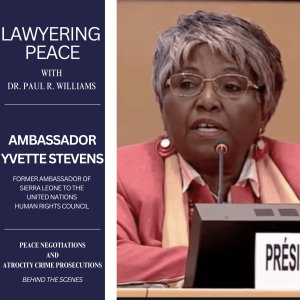
Ambassador Yvette Stevens, Sierra Leone's first female engineer, reflects on her groundbreaking diplomatic career at the United Nations and her nation’s tumultuous journey to peace during and after the civil war (1991–2002). In this compelling episode, she delves into the complex dynamics of the Sierra Leone Civil War, the controversial Lomé Peace Accord, and the innovative Special Court for Sierra Leone.
Ambassador Stevens shares her perspective on the delicate balance between peace and justice, revealing how the Special Court for Sierra Leone was established despite the Lomé Agreement’s amnesty provision. While Sierra Leonean citizens initially may have wished that more international resources were put towards reconstructing the country rather than to pursuing justice, the Special Court proved groundbreaking, achieving several firsts in international law, including:
Prosecution of child soldier recruitment.
Conviction of forced marriage as a crime against humanity.
Prosecutions for attacks on UN workers.
The first trial and conviction of a former head of state since Nuremberg.
Gain unique insights into Sierra Leone’s path to peace, the importance of gender-inclusive negotiations, and the enduring power of human rights as a cornerstone for lasting stability in this episode.
Tuesday Feb 04, 2025
Tuesday Feb 04, 2025
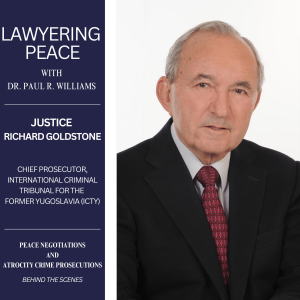
In this episode, Justice Richard Goldstone recounts his remarkable journey from working within the South African justice system to dismantle apartheid to serving as the first Chief Prosecutor for the International Criminal Tribunals for the former Yugoslavia (ICTY) and Rwanda (ICTR). He delves into the challenges of pursuing justice amid political resistance, from using judicial discretion to challenge oppressive laws and expose state-sponsored violence, to navigating the complexities of UN bureaucracy and funding constraints. Goldstone reflects on the groundbreaking impact of the ICTY on international law, including advancements in prosecuting gender-based crimes, and the enduring tension between peace and justice. His insights underscore the critical connection between justice, accountability, and sustainable peace.
Tuesday Jan 28, 2025
Tuesday Jan 28, 2025
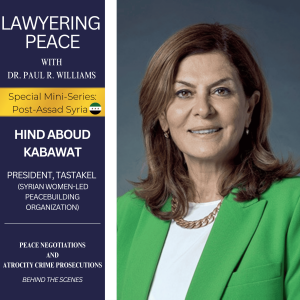
In this episode, Hind Kabawat shares her recent experiences returning to Damascus after 14 years, reflecting on a nation scarred by war yet brimming with hope. Hind, a key figure in Syrian peace negotiations and a staunch advocate for women's inclusion, discusses the vital role women play in shaping Syria's future. From leading educational initiatives in refugee camps to advocating for transitional justice, Syrian women are rewriting their narrative as changemakers, not bystanders.
Hind delves into the challenges and opportunities of a future Syrian National Dialogue, highlighting the importance of gender equality, trust-building, and inclusive representation to ensure a sustainable peace. She emphasizes that women must be at the forefront—crafting policy, driving justice, and fostering dialogue—so Syria can achieve lasting stability.
Tune in to hear Hind's powerful insights on how Syrian women are leading the charge for justice, reconstruction, and a brighter future, proving that resilience and hope are unyielding forces in the face of adversity.
This episode is part of our Post-Assad Syria mini-series, where we speak with experts deeply involved in Syria’s peace processes. Together, we’ll reflect on lessons learned, explore the nation’s crossroads, and discuss how to seize this moment of change for a brighter future.
-------------------
Syria has entered a transformative moment. After over a decade of devastating civil war, the Assad regime has been overthrown, marking a seismic shift in the nation's trajectory. While this moment brings immense hope, it also presents profound challenges—rebuilding communities, addressing sectarian divides, and navigating the complexities of international dynamics.
In our latest mini-series, the Lawyering Peace Podcast dives into this pivotal moment for Syria. Through in-depth conversations with experts deeply involved in Syria’s peace processes, we reflect on lessons learned, explore the nation’s crossroads, and discuss what it takes to turn this moment of change into a foundation for lasting peace.
Tuesday Jan 28, 2025
Tuesday Jan 28, 2025
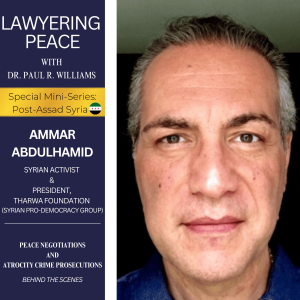
In this episode of the Lawyering Peace podcast’s Post-Assad Syria Mini-Series, Syrian intellectual and activist Ammar Abdulhamid offers an in-depth analysis of Syria’s transitional moment and the challenges ahead. Drawing on decades of advocacy for democratic reform and his experience briefing world leaders, Ammar discusses the current sentiment on the ground, the promise of a resurgent civil society, and the critical role of governance.
He highlights the importance of fostering inclusivity amidst Syria's rich religious and cultural diversity, the necessity for international partners to listen to local voices, and the delicate balancing act facing new leadership. Ammar also outlines the opportunities for the U.S. and its allies to support this transition and examines the lessons Syria can draw from past Arab Spring movements.
Tune in for a nuanced perspective on Syria’s complex political and societal dynamics, the role of civil society, and the international community’s path to meaningful engagement.
--------------------
Syria has entered a transformative moment. After over a decade of devastating civil war, the Assad regime has been overthrown, marking a seismic shift in the nation's trajectory. While this moment brings immense hope, it also presents profound challenges—rebuilding communities, addressing sectarian divides, and navigating the complexities of international dynamics.
In our latest mini-series, the Lawyering Peace Podcast dives into this pivotal moment for Syria. Through in-depth conversations with experts deeply involved in Syria’s peace processes, we reflect on lessons learned, explore the nation’s crossroads, and discuss what it takes to turn this moment of change into a foundation for lasting peace.
Wednesday Jan 22, 2025
Wednesday Jan 22, 2025
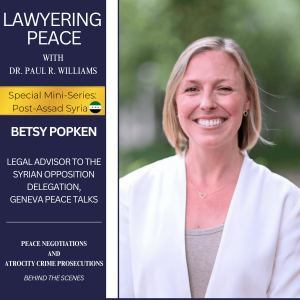
In this episode of our Lawyering Peace Podcast Post-Assad Syria Mini Series, we sit down with Betsy Popken, Chief Legal Advisor to the Syrian Opposition during the Geneva Peace Talks. Betsy shares her unique insights into the challenges and opportunities facing Syria in the wake of the Assad regime, exploring the groundwork laid for transitional justice, governance, and reconciliation.
As Syria grapples with economic hardship, damaged infrastructure, and the formation of an interim government, Betsy evaluates the role of Hay’at Tahrir al-Sham (HTS) in shaping a more inclusive future. While HTS has made promises about incorporating diverse voices—including Alawites, Druze, and women—Betsy emphasizes the need for tangible action to match rhetoric.
From the potential of a national dialogue to create a new constitution to the role of civil society organizations in fostering reconciliation, Betsy discusses how Syrians can build a democracy rooted in collaboration and shared goals. She also cautions against replicating the missteps of past Arab Spring transitions and underscores the importance of learning from those experiences.
Join us for a compelling conversation about the hopes, challenges, and critical decisions shaping Syria’s transition, as well as the lessons the international community and Syrians themselves can draw on to create a more inclusive and just future.
--------------------------
Syria has entered a transformative moment. After over a decade of devastating civil war, the Assad regime has been overthrown, marking a seismic shift in the nation's trajectory. While this moment brings immense hope, it also presents profound challenges—rebuilding communities, addressing sectarian divides, and navigating the complexities of international dynamics.
In our latest mini-series, the Lawyering Peace Podcast dives into this pivotal moment for Syria. Through in-depth conversations with experts deeply involved in Syria’s peace processes, we reflect on lessons learned, explore the nation’s crossroads, and discuss what it takes to turn this moment of change into a foundation for lasting peace.
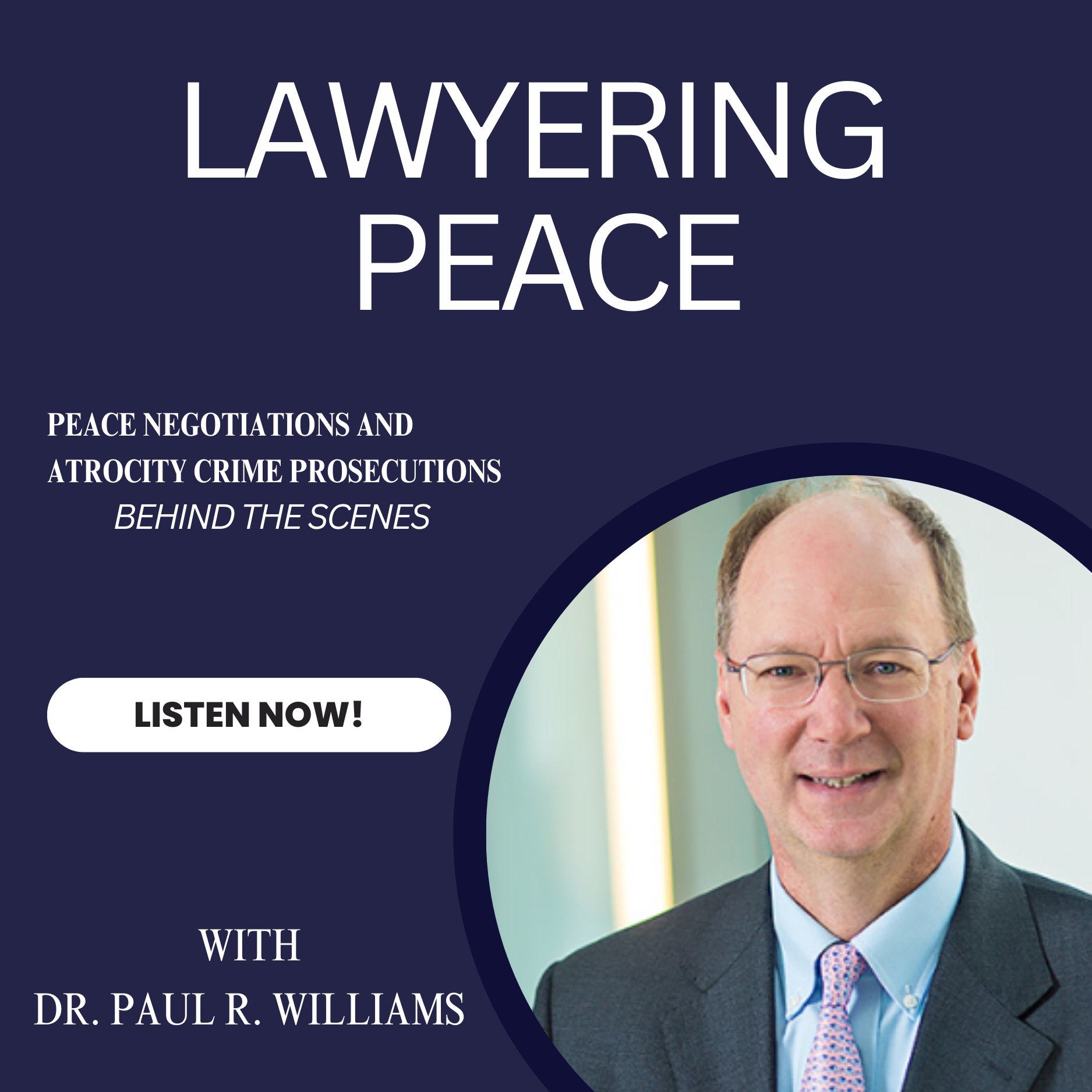
Lawyering Peace Interview Series
Join Dr. Paul R. Williams, as he delves into the realm of peace negotiations, diplomacy, and international criminal justice with guests including seasoned peace negotiators and mediators, legal and strategic advisors, former ambassadors, prosecutors, and veterans of international criminal tribunals. Through the conversations, Dr. Williams and his guests shed light on the hurdles and triumphs of peace talks, the intricacies of negotiation strategies, the rigorous pursuit of justice in the aftermath of atrocities, and, in some instances, the lessons learned from failure. This series is a platform for the insights and wisdom of the friends and colleagues that Dr. Williams has had the honor of working with for over 30 years in the field, and offers an insider’s perspective on the complex dynamics of seeking justice and durable peace on the international stage.